Blogia

Just Call Me Angel

Is Together Through Life co-written - yes, with Robert Hunter

www.huffingtonpost.com]|bobdylancom|20090415

In anticipation of the release of his 33rd album, Together Through Life, Bob Dylan sat down with rock critic and MTV producer Bill Flanagan for a rare and unusually candid conversation. The first three portions of their meeting can be read at bobdylan.com, and the fourth installment can be read here on the Huffington Post).

In the fifth installment, published below, Dylan reveals his favorite songwriters, discusses whether he's a cult figure, and gives his thoughts on trading on nostalgia and if he's a mainstream artist.


Bill Flanagan: Going back to that song you wrote for the movie that you mentioned earlier, "Life is Hard," has the formality of an old Rudy Vallee or Nelson Eddy ballad right down to the middle eight ("Ever since the day..."). Do you figure that if you start a song in that style, you stick with the rules right down the line?

Bob Dylan: Sure, I try to stick to the rules. Sometimes I might shift paradigms within the same song, but then that structure also has its own rules. And I combine them both, see what works and what doesn't. My range is limited. Some formulas are too complex and I don't want anything to do with them.

BF: "Forgetful Heart" - how do you decide to put an Appalachian banjo on a minor key blues? Is it something you think of ahead of time or does it come up in the session?

BD: I think it probably came up at the studio. A banjo wouldn't be out of character though. There is a minor key modality to "Forgetful Heart." It's like Little Maggie or Darling Cory, so there is no reason a banjo shouldn't fit or sound right.

BF: You wrote a lot of these songs with Robert Hunter. How does that process work?

BD: There isn't any process to speak of. You just do it. You drive the car. Sometimes you get out from behind the wheel and let someone else step on the gas.

BF: You must have known Hunter a long time. Do you remember where you first met?

BD: It was either back in '62 or '63 when I played in the Bay area. I might have met him in Palo Alto or Berkley or Oakland. I played all those places then and I could have met Hunter around that time. I know he was around.

BF: Didn't Hunter play in a bluegrass band with Jerry Garcia?

BD: Yeah, it was either that or a jug band.

BF: Have you ever thought about composing anything with those Nashville songwriters?

BD: I've never thought about that.

BF: Neil Diamond did an album years ago where he co-wrote with different Nashville songwriters.

BD: Yeah, that might have worked for him. I don't think it would work for me.

BF: You don't think it would work for you?

BD: No. I'm okay without it. I'm not exactly obsessed with writing songs. I go back a ways with Hunter. We're from the same old school so it makes it's own kind of sense.

BF: Do you listen to a lot of songs?

BD: Yeah - sometimes.

BF: Who are some of your favorite songwriters?

BD: Buffett I guess. Lightfoot. Warren Zevon. Randy. John Prine. Guy Clark. Those kinds of writers.

BF: What songs do you like of Buffett's?

BD: "Death of an Unpopular Poet." There's another one called "He Went to Paris."

BF: You and Lightfoot go way back.

BD: Oh yeah. Gordo's been around as long as me.

BF: What are your favorite songs of his?

BD: "Shadows," "Sundown," "If You Could Read My Mind." I can't think of any I don't like.

BF: Did you know Zevon?

BD: Not very well.

BF: What did you like about him?

BD: "Lawyers, Guns and Money." "Boom Boom Mancini." Down hard stuff. "Join me in L.A." sort of straddles the line between heartfelt and primeval. His musical patterns are all over the place, probably because he's classically trained. There might be three separate songs within a Zevon song, but they're all effortlessly connected. Zevon was a musician's musician, a tortured one. "Desperado Under the Eaves." It's all in there.

BF: Randy Newman?

BD: Yeah, Randy. What can you say? I like his early songs, "Sail Away," "Burn Down the Cornfield," "Louisiana," where he kept it simple. Bordello songs. I think of him as the Crown Prince, the heir apparent to Jelly Roll Morton. His style is deceiving. He's so laid back that you kind of forget he's saying important things. Randy's sort of tied to a different era like I am.

BF: How about John Prine?

BD: Prine's stuff is pure Proustian existentialism. Midwestern mindtrips to the nth degree. And he writes beautiful songs. I remember when Kris Kristofferson first brought him on the scene. All that stuff about "Sam Stone" the soldier junky daddy and "Donald and Lydia," where people make love from ten miles away. Nobody but Prine could write like that. If I had to pick one song of his, it might be "Lake Marie." I don't remember what album that's on.

BF: A lot of the acts from your generation seem to be trading on nostalgia. They play the same songs the same way for the last 30 years. Why haven't you ever done that?

BD: I couldn't if I tried. Those guys you are talking about all had conspicuous hits. They started out anti-establishment and now they are in charge of the world. Celebratory songs. Music for the grand dinner party. Mainstream stuff that played into the culture on a pervasive level. My stuff is different from those guys. It's more desperate. Daltrey, Townshend, McCartney, the Beach Boys, Elton, Billy Joel. They made perfect records, so they have to play them perfectly ... exactly the way people remember them. My records were never perfect. So there is no point in trying to duplicate them. Anyway, I'm no mainstream artist.

BF: Then what kind of artist are you?

BD: I'm not sure, Byronesque maybe. Look, when I started out, mainstream culture was Sinatra, Perry Como, Andy Williams, Sound of Music. There was no fitting into it then and of course, there's no fitting into it now. Some of my songs have crossed over but they were all done by other singers.

BF: Have you ever tried to fit in?

BD: Well, no, not really. I'm coming out of the folk music tradition and that's the vernacular and archetypal aesthetic that I've experienced. Those are the dynamics of it. I couldn't have written songs for the Brill Building if I tried. Whatever passes for pop music, I couldn't do it then and I can't do it now.

BF: Does that mean you create outsider art? Do you think of yourself as a cult figure?

BD: A cult figure, that's got religious connotations. It sounds cliquish and clannish. People have different emotional levels. Especially when you're young. Back then I guess most of my influences could be thought of as eccentric. Mass media had no overwhelming reach so I was drawn to the traveling performers passing through. The side show performers - bluegrass singers, the black cowboy with chaps and a lariat doing rope tricks. Miss Europe, Quasimodo, the Bearded Lady, the half-man half-woman, the deformed and the bent, Atlas the Dwarf, the fire-eaters, the teachers and preachers, the blues singers. I remember it like it was yesterday. I got close to some of these people. I learned about dignity from them. Freedom too. Civil rights, human rights. How to stay within yourself. Most others were into the rides like the tilt-a-whirl and the rollercoaster. To me that was the nightmare. All the giddiness. The artificiality of it. The sledge hammer of life. It didn't make sense or seem real. The stuff off the main road was where force of reality was. At least it struck me that way. When I left home those feelings didn't change.

BF: But you've sold over a hundred million records.

BD: Yeah I know. It's a mystery to me too.
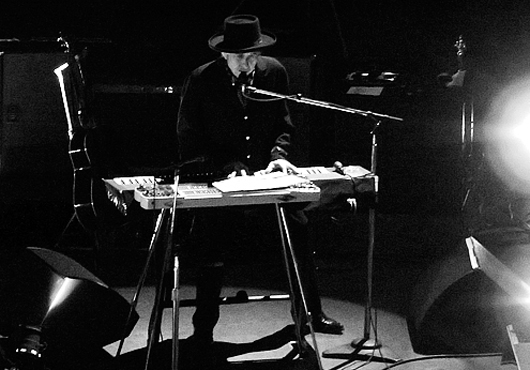
Milan, Italy April 15, 2009

Milan, Italy
Assago DatchForum
April 15, 2009

1. The Wicked Messenger (Bob on keyboard)
2. Just Like Tom Thumb's Blues (Bob on guitar)
3. Just Like A Woman (Bob on keyboard)
4. Rollin' And Tumblin' (Bob on keyboard)
5. A Hard Rain's A-Gonna Fall (Bob on keyboard)
6. High Water (For Charley Patton) (Bob on keyboard)
7. Sugar Baby (Bob on keyboard)
8. Stuck Inside Of Mobile With The Memphis Blues Again
(Bob on keyboard)
9. Blind Willie McTell (Bob on keyboard)
10. Desolation Row (Bob on keyboard)
11. Honest With Me (Bob on keyboard)
12. Ballad Of A Thin Man (Bob on keyboard)
13. When The Deal Goes Down (Bob on keyboard)
14. Thunder On The Mountain (Bob on keyboard)
15. Like A Rolling Stone (Bob on keyboard)

(encore)

16. All Along The Watchtower (Bob on keyboard)
17. Spirit On The Water (Bob on keyboard)
18. Blowin' In The Wind (Bob on keyboard)

On the situation today

Esta bien, si quieren reformas.... 1º liquidación total de las autonomías. 2º Cierre de todos los canales públicos de televisión deficitarios. 3º Fuera pensiones a los politicuchos por haber sido ministro, presidente o lo que sea. 4º Quien no cotice los sufientes años, ni un euro del erario público. 5º Sueldo de los diputados 1.000 Euros al mes (y ya tienen bastante). 6º Para que los políticos opten a una pension de jubilación que coticen 30 ó 40 años como todo hijo de vecino. No sigo más para no daros el coñazo... Saludos cordiales a todos.
Y a quien le importan las pensiones...??? A todos éstos vividores del pesebre público les da lo mismo, ellos con sus sueldazos y comisiones por doquier tienen las arcas llenas y las cuentas de Suiza repletas... mientras el borreguerío no se entera de la película, así que ¿a quien importa la ruina y el crack de las pensiones, a los que estamos aguantando como sea la crisis con nuestras empresas, para no perder lo poco que hemos conseguido durante toda nuestra vida... ? El día que salte alguien a cortar cuellos de políticos y vividores, yo estaré a su lado, necesitamos otra revolución social contra los apesebrados, contra la casta de malnacidos que viven de nuestra sangre sin importarles para nada nuestras vidas, !! guillotina otra vez, guillotina ya!!
Y si las pensiones peligran, los que estamos a punto de jubilarnos vamos a seguir en activo hasta el "Día del Juicio Final, por la tarde", con lo que los jóvenes entrarán a trabajar en los puestos que dejemos, cuando "las ranas críen pelo", lo que implica aumento del paro en las generaciones mas jóvenes que aun estan por licenciarse.

Si las pensiones peligran, los viejos serán los paganos de las veleidades zapateriles. ¡Que se vayan preparando los "jubilatas"!.

¡Como estará la cosa para que un socialista tan sectario como MAFO, dice que hay que contener el gasto!. No preocuparse, Zapatero ya dijo que el gasto en pensiones, sanidad y salario de los trabajadores, no se iban a contener por que no iban a ser ellos quienes "pagaran el pato".

¡Lo que nos tenemos que reir!, .... por no llorar.

¡Mas no importa!. Pobres, pero progres, los mas progres del mundo, como Cuba, Birmania y Corea del Norte..... pero aqui con monarquía.

On Bob Dylan’s new album ›Together Through Life

on Bob Dylan’s new album ›Together Through Life‹

Text: Max Dax, Alex Paulick

Alongside the American publications Rolling Stone and the New Yorker, the British magazines Mojo and Uncut, Spex is one of three German magazines to have been granted a listening session of the new album by Bob Dylan, entitled »Together Through Life«. Max Dax was able to listen to it twice altogether – so it is still too early for a comprehensive, well founded critique. But his notes – a rough protocol in illegible stenography – were sufficient for a song-by-song review as the first part of the big Spex Online special on Bob Dylan - with the explicit possibility of wrongly heard and therefore incorrectly quoted song lyrics.

    The album – by a long way the most nervously anticipated by fans and press so far this year – turns out to be a surprising and entirely well-rounded record, with a marked Mexican/Cajun influence. It sounds like a summer album, full of longing for the American South and a time that is lost forever. While on his previous records »Love & Theft« (2001) and »Modern Times« (2006) Dylan was still singing in bitter protest against those modern times and evoking old epochs, it seems that the meanwhile 67 year old singer has at last made peace with the fact that no one can alter the march of time. And In the face of this irrefutable knowledge, the only thing that helps is - an accordion!


Translated from German by Alex Paulick (Coloma)
Siehe auch: Dieser Artikel auf deutsch / This article in German


1. »Beyond Here Lies Nothin’«

We hear a trumpet, an accordion, a low-tuned acoustic guitar, a Hammond organ and a pumping electric bass - but the band is driven by the rumba-blues rhythm of the drums. Bob Dylan opens his new album with the lines: »Oh well I love you pretty baby / You’re the only love I’ve ever known / Just as long as you stay with me / The whole world is my throne / Beyond here lies nothing / Nothing we can call our own.« It is a love song of the raw, disillusioned kind, which holds its appeal by virtue of the band’s rough-hewn pleasure in playing.

    Surprising are the choice of rhythm and the disarming sound palette: a Latin feel is present, suggesting a "south-of-the-border" mood - an American expression referring to Mexican music and the way of life beyond the Rio Grande. The accordion as a rhythmic element and the trash-can blues trumpet are striking, and might otherwise suggest a similarity to Tom Waits – although Dylan sings much less theatrically and isn’t angling for an effect.

    »Beyond Here Lies Nothin’« is the perfect opener, manifesting an easiness which marks out the territory of the whole album. With the accordion, it seems as if Dylan is intentionally expanding the sound of his long-standing live band, using the new instrument as a kind of wild card. The western swing references, which for all intents and purposes were exhausted after »Love & Theft« and »Modern Times«, have been discarded. A surprising looseness is established, and seems to announce that the deck has been reshuffled! On accordion: David Hidalgo of Los Lobos from East L.A.


2. »Life Is Hard«

The instrumentation of this slow, sentimental ballad suggests the sound of the thirties or forties: steel guitar, mandolin, accordion, brushed drums, upright bass. Dylan sings with tender, onomatopoeic phrasing: »The sun is sinking low / I guess it’s time to go / I feel a chilly breeze / In place of memories / My dreams are locked and barred / Admitting life is hard / Without you near me.« The intriguing rhythmic interplay between the straight vocal line and swinging jazz drums leaves the tune floating in a state of ambiguity. Apparently, this song was the genesis of »Together Through Life«. It was originally written by Dylan as a contribution to »My Own Love Song«, a new film by Olivier Dahan, and was recorded in October of last year. During the work on this song, Dylan saw the beginnings of something bigger, which led him to extend the recording sessions, resulting in the ten new songs on this album.


3. »My Wife’s Home Town«

An ironic, at first seemingly threatening blues tune. This song probably most clearly demonstrates what Dylan means in a recent interview with Bill Flanagan on Bobdylan.com (PDF) when he talks about the influence of the sound of the Chicago blues label Chess Records. This track, slightly too slow to be roadhouse blues, very much resembles Muddy Waters classics like »Mannish Boy« or »I Just Wanna Make Love to You«. Yet the accordion plays unexpectedly bright major chords and Dylan foils the mood, grumbling with twinkle in his eye: »She can make you steal / Make you rob / Give you the hives / Make you lose your tongue / Can make things bad / She can make things worse / She got stuff more potent than a gypsy curse«. The lasting impression is of something like Muddy Waters singing a Lyle Lovett song: »There ain’t no way to put me down / I just wanna say that Hell’s my wife’s home town«. After adding a long »hoooooometown« to the last chorus, Dylan even laughs diabolically before the song fades out.


4. »If You Ever Go to Houston«

The musical atmosphere of this outstanding song evokes cinematic images. The sea breeze that blows across the Gulf of Mexico into Texas also blows through this song. It has a vague echo of some old Cajun standard, the title of which the singer has since forgotten. But the piece is a little too slow to be a Cajun tune - like most songs on »Together Through Life« seem ›too slow‹ for their referential genre in a strangely pleasant way. The pedal steel, organ and accordion block out the optimistic riff throughout the track, and the relaxed shuffle is driven by acoustic guitar and brushes.

    Dylan sings in the spaces which open up in between: »If you are ever down there / (…) / You better watch out for the man with the shining star / Better know where you are going / Or stay where you are«, or: »I know these streets / I’ve been here before / I nearly got killed here / During the Mexican War«. With these lyrics he makes unequivocally clear that the Texan-Mexican border town feeling is not only meant musically, but word for word - and not only in this piece, but throughout the entire record. Also worth mentioning is that Dylan is really singing here: he holds the notes, singing emphatically with a joyful passion. This is something we haven’t heard from him in years.


5. »Forgetful Heart«

The most unspectacular song on »Together Through Life«: organ pads, a sluggish beat, tambourine, a distorted steel guitar and the accordion meandering in the background. In its form, »Forgetful Heart« reminds of slower, late Dylan classics like »Nettie Moore« or »Ain’t Talkin’« or »Can’t Wait« – but lacks the observational clarity and literary precision of those songs. Perhaps it is due to the subject matter? Dylan sings: »Forgetful heart / Lost your power of recall / Every little detail / You don’t remember at all / The times we knew / Who would remember better than you?«

Bob Dylan Mailand
Bob Dylan in concert in Milan, November 2005. He will visit Germany and Switzerland in April 2009 as part of his European tour. Presented by Spex Magazine. Don’t you dare miss it!

(Photo: CC ISphoto / Flickr)

6. »Jolene«

Another song written in a roadhouse blues frame: in »Jolene« the shuffle driven by the electric guitar motif reminds of Little Richard's »Lucille«, but the song is maybe too slow for this musical comparison. The phrase »I am the king and you are the queen / Jolene« invites another comparison, to David Bowie's »Heroes«, and the lines: »I could be king and you could be queen«. Along with »Forgetful Heart« this is another song where format is more pronounced than originality. But all the songs on »Together Through Life«, including the less strong ones like »Jolene«, are driven by a simplicity which predestines them to be played live often and extensively.

    The overall sound of the album contributes to an assumption: This is a spontaneous recording. Again and again little flubs and bum notes are audible, which assumedly haven't been corrected or rerecorded for the sake of this impression. The songs are written more simply as well, as if Dylan didn't want to invest so much time as to burden the songs with excessive encryption, levels of interpretation and abstraction, but rather to capture a moment. In this respect, »Together Through Life« has something in common with the 19 year old album »Under the Red Sky«. But where that album suffers noticeably under the heavy handed Don Was production values of 1990, and the mixing desk was often more audible than the live room, Dylan's new record profits from a real-time naturalism which wasn't obviously or artificially manipulated through post-production.


7. »This Dream of You«

First impression: singer and band are back in Mexico. To be more precise, with this song Dylan conjures up the aesthetic and the romantic-melancholic mood of his own classic »Romance In Durango« from 1976. Accordion, upright bass and fiddle form the backbone of this slow rumba-ballad. One of the most beautiful lines, not only of this song, but of the entire album, says: »There is a moment where all things become new again / But that moment might have come and gone / All I have and all I know / Is this dream of you / That keeps me moving on«. Dylan doesn't cultivate the old notion of Mexico as an exotic place of longing only with this song - as early as 1963 he wrote the lines »I’ve heard tell of a town / Where I might as well be bound / It’s down around / The old Mexican plains« in the song »Farewell«. Although the outtake from the »The Times They Are A’Changing« sessions was never released, he returned to the subject in »Just Like Tom Thumb's Blues« from 1965 – »When you’re lost in the rain in Juarez / And it’s Eastertime too«. Not to mention that albums like »Desire« or »Pat Garrett & Billy the Kid« are choc full of such references.


8. »Shake Shake Mama«

An abrupt change of mood: in this rumbling barroom stomp Dylan shoots off a fireworks display of innuendos and sexual connotations: »Shake shake Mama / Shake like a ship going out to sea« (…) »I get the blues for you baby / When I look up at the sun / Come back here / We can have some real fun« (…) »Shake shake Mama / Shake until the break of day / I’m right here baby / I’m not that far away«. A song like this reemphasizes the previously mentioned comparison with »Under the Red Sky«, suggesting that »Shake Shake Mama« is the »Wiggle Wiggle« of this record, simply adding another song to a genre – and therefore absolutely legible as an artistic defensive reaction against the efforts to weigh each and every one of Dylan's syllables on a gold scale.


9. »I Feel a Change Comin’ On«

Alongside »If You Ever Go to Houston«, »My Wife’s Home Town« and »This Dream of You«, this is one of the outstanding songs on the new album. One of the two key verses says: »What’s the use in dreaming / You got better things to do / Dreams never did work for me anyway / Even when they are getting true«. The other: »Some people they tell me / I’ve got the blood of the land in my voice«. That might sound heavy and fatalistic, but it is countered by Dylan's crooning voice. It appears that an optimist is singing the sunny hook line: »I feel a change comin’ on« – an impression that is immediately tempered one line later with Dylan's cryptic statement: »And the fourth part of the day is already gone«.

    During an interview with the London newspaper The Times, given last year in Denmark, Dylan was atypically outspoken in his sympathy for the presidential candidate Barack Obama. This song sounds as if he would now like to say, after the election: »surely some things will change for the better, but it's too late anyway«. Although the song is sung happily, it speaks for the prophetic interpretation that throughout this album, Dylan is apparently quoting entire lines from Chaucer's »Canterbury Tales« – that quintessential tome of English literature from the 14th century, which among other topics includes the misuse of religion for political ends. But before we get caught up in over-interpretation, it should be mentioned that »I Feel a Change Comin’ On« is pretty darned similar to »Handy Dandy« in its lively and happy mood. That nursery-rhyme-like number is yet another song from the aforementioned »Under the Red Sky«. Of all songs –  and after nearly two decades –  Dylan played it live for the very first time last year, on the 28th of June in Vigo, Spain. Perhaps it occurred to him that it might be worth revisiting the simplicity of this song, or for that matter, the entire record.


10. »It’s All Good«

The last song of this remarkable album, »It’s All Good«, might still be a little to slow for a Zydeco tune, even despite the driving accordion and its Cajun shuffle rhythm. Here, Dylan displays his sarcastic side: similarly to in his song »Everything Is Broken« from 1989, he lists things that are going wrong, to finally comment with a dry »It’s all good«. Considering that this is the closing chapter of an album which is to be released in the dark days of a financial crisis, perhaps the biggest crisis in the history of capitalism, the song rattles on breathlessly like a freight train, and is beyond all seriousness.


    Dylan sings of »Wives leaving their husbands« and »Big politicians telling lies«, but: »It’s all good«. »Brick by brick they tear you down / A teacup of water is enough to drown / You oughta know if they could they would / Whatever goes down / It’s all good«. In the past it has been the case that ›easier‹ or ›more lively‹ Dylan records preceded an artistic fresh start for the singer. After »Street Legal« followed »Slow Train Coming«, after »Under the Red Sky« the album »Good As I Been to You«, after »Another Side …« came »Bringing It All Back Home«. So what does the future hold? Dylan alone at the piano? We are prepared for anything.


Amsterdam, The Netherlands April 11, 2009

Amsterdam, The Netherlands
Heineken Music Hall
April 11, 2009

1. Maggie's Farm (Bob on keyboard)
2. Mr. Tambourine Man (Bob on keyboard)
3. Man In The Long Black Coat (Bob on keyboard)
4. The Levee's Gonna Break (Bob on keyboard)
5. When The Deal Goes Down (Bob on keyboard)
6. Things Have Changed (Bob on keyboard)
7. The Lonesome Death Of Hattie Carroll (Bob on keyboard)
8. Tough Mama (Bob on keyboard)
9. Workingman's Blues #2 (Bob on keyboard)
10. It's Alright, Ma (I'm Only Bleeding) (Bob on keyboard)
11. Just Like A Woman (Bob on keyboard)
12. Highway 61 Revisited (Bob on keyboard)
13. Nettie Moore (Bob on keyboard)
14. Thunder On The Mountain (Bob on keyboard)
15. Like A Rolling Stone (Bob on keyboard)

(encore)

16. All Along The Watchtower (Bob on keyboard)
17. Spirit On The Water (Bob on keyboard)
18. Blowin' In The Wind (Bob on keyboard)

On the situation today

¿Qué respeto nos merecen las decisiones del Tribunal Supremo que acaba de exculpar a un juez que cometió prevaricación y cohecho en el caso de Marbella? Es un Tribunal que está adoptando decisiones sospechosamente corporativas constantemente. Es un Tribunal que a semejanza del Constitucional, adopta decisiones presuntamente injustas sabiendo que contra ellos ya no se puede hacer nada... y encima asumiendo que lo políticamente correcto es "aceptar sus decisiones". Cuando a un juez que debía haber ido dos años a la cárcel más no sé cuantos de inhabilitación según una instancia judicial por haber recibido dinero de un acusado, este Tribunal prácticamente le esculpa y le permite seguir en su juzgado ¿qué respeto nos pueden merecer sus decisiones? Somos víctimas de esta justicia de... y nadie nos puede negar que, sea cualquiera que sea la decisión que tomen, todos tengamos derecho a sospechar que han sido “comprados”. Ninguna decisión judicial podemos asumir que sea justa. Y ante esta exculpación del juez del caso Marbella ¿cómo se va perjudicar a Garzón que cobró del Banco de Santander para archivar una causa contra su presidente? Y abundando sobre este presunto juez ¿qué sabe Garzón y a cuántos tienen “cogidos” por los... delitos para que se le permita todo tipo de atropello? Ya lo advirtió desde Nueva York: “Cuando vuelva ya hablaré pero quizá me rueguen que me calle...” ¿Sabe quienes fueron los autores intelectuales y materiales del 11-M? Ya se sabe que desde el 11-M España empezó a ser eZpaña... y todo lo que ocurre está contaminado por las consecuencias de aquel “golpe de estado”.

Paris, France April 8, 2009

Paris, France
Palais des Congrès de Paris
April 8, 2009

1. The Wicked Messenger (Bob on keyboard)
2. Lay, Lady, Lay (Bob on guitar)
3. Things Have Changed (Bob on keyboard)
4. When The Deal Goes Down (Bob on keyboard and harp)
5. 'Til I Fell In Love With You (Bob on keyboard and harp)
6. Stuck Inside Of Mobile With The Memphis Blues Again
(Bob on keyboard and harp)
7. Sugar Baby (Bob on keyboard)
8. It's Alright, Ma (I'm Only Bleeding) (Bob on keyboard)
9. The Lonesome Death Of Hattie Carroll (Bob on keyboard)
10. Tweedle Dee & Tweedle Dum (Bob on keyboard and harp)
11. Beyond The Horizon (Bob on keyboard)
12. Highway 61 Revisited (Bob on keyboard)
13. The Times We've Known (Bob on keyboard) (song by Charles Aznavour)
14. Thunder On The Mountain (Bob on keyboard)
15. Like A Rolling Stone (Bob on keyboard)

(encore)

16. All Along The Watchtower (Bob on keyboard)
17. Spirit On The Water (Bob on keyboard)
18. Blowin' In The Wind (Bob on keyboard)

Dylan on Mysticism, Obama the South

Exclusive Excerpt: Dylan on Mysticism, Obama the South

Newsweek

In an exclusive excerpt from a recent interview, Bob Dylan talks with author Bill Flanagan about Barack Obama, the ghosts of the Civil War and presidential autobiographies.

Bill Flanagan: You liked Barack Obama early on. Why was that?
Bob Dylan: I'd read his book and it intrigued me.

"Audacity of Hope"?
No, it was called "Dreams [From] My Father." 

What struck you about him?
Well, a number of things. He's got an interesting background. He's like a fictional character, but he's real. First off, his mother was a Kansas girl. Never lived in Kansas, though, but with deep roots. You know, like Kansas bloody Kansas. John Brown the insurrectionist. Jesse James and Quantrill. Bushwhackers, guerillas. Wizard of Oz Kansas. I think Barack has Jefferson Davis back there in his ancestry someplace. And then his father. An African intellectual. Bantu, Masai, Griot-type heritage--cattle raiders, lion killers. I mean, it's just so incongruous that these two people would meet and fall in love. You kind of get past that, though. And then you're into his story. Like an odyssey, except in reverse.

In what way?
First of all, Barack is born in Hawaii. Most of us think of Hawaii as paradise, so I guess you could say that he was born in paradise.

And he was thrown out of the garden.
Not exactly. His mom married some other guy named Lolo and then took Barack to Indonesia to live. Barack went to both a Muslim school and a Catholic school. His mom used to get up at 4 in the morning and teach him book lessons three hours before he even went to school. And then she would go to work. That tells you the type of woman she was. That's just in the beginning of the story.

What else did you find compelling about him?
Well, mainly his take on things. His writing style hits you on more than one level. It makes you feel and think at the same time, and that is hard to do. He says profoundly outrageous things. He's looking at a shrunken head inside of a glass case in some museum with a bunch of other people, and he's wondering if any of these people realize that they could be looking at one of their ancestors.

What in his book would make you think he'd be a good politician?
Well, nothing really. In some sense, you would think being in the business of politics would be the last thing that this man would want to do. I think he had a job as an investment banker on Wall Street for a second, selling German bonds. But he probably could've done anything. If you read his book, you'll know that the political world came to him. It was there to be had. 

Do you think he'll make a good president?
I have no idea. He'll be the best president he can be. Most of those guys come into office with the best of intentions and leave as beaten men. Johnson would be a good example of that … Nixon, Clinton in a way, Truman, all the rest of them going back. You know, it's like they all fly too close to the sun and get burned.

Did you ever read any other presidential autobiographies?
Yeah, I read Grant's.

What was he like? Any similarities?
The times were different, obviously. And Grant wrote his book after he'd left office.

What did you find interesting about him?
It's not like he's a great writer. He's analytical and cold, but he does have a sense of humor. Grant, besides being a military strategist, was a working man. Worked horses. Tended the horses, plowed and furrowed. Brought in all the crops--the corn and potatoes. Sawed wood and drove wagons since the time he was about 11. Got a crystal-clear memory of all the battles he’d been in.

Do you remember any particular battle that Grant fought?
There were a lot of battles, but the Shilo one is most interesting. He could've lost that. But he was determined to win it at any price, using all kinds of strategies, even faking retreat. You could read it for yourself.

When you think back to the Civil War, one thing you forget is that no battles except Gettysburg were fought in the North.
Yeah. That's what probably makes the Southern part of the country so different.

There is a certain sensibility, but I'm not sure how that connects.
It must be the Southern air. It's filled with rambling ghosts and disturbed spirits. They're all screaming and forlorning. It's like they are caught in some weird web--some purgatory between heaven and hell and they can't rest. They can't live, and they can't die. It's like they were cut off in their prime, wanting to tell somebody something. It's all over the place. There are war fields everywhere … a lot of times even in people's backyards.

Have you felt them?
Oh, sure. You'd be surprised. I was in Elvis's hometown, Tupelo. And I was trying to feel what Elvis would have felt back when he was growing up.

Did you feel all the music Elvis must have heard?
No, but I'll tell you what I did feel. I felt the ghosts from the bloody battle that Sherman fought against Forrest and drove him out. There's an eeriness to the town. A sadness that lingers. Elvis must have felt it too. 

Are you a mystical person?
Absolutely. 

Any thoughts about why?
I think it's the land. The streams, the forests, the vast emptiness. The land created me. I'm wild and lonesome. Even as I travel the cities, I'm more at home in the vacant lots. But I have a love for humankind, a love of truth, and a love of justice. I think I have a dualistic nature. I'm more of an adventurous type than a relationship type.

But the new album is all about love--love found, love lost, love remembered, love denied.
Inspiration is hard to come by. You have to take it where you find it.